
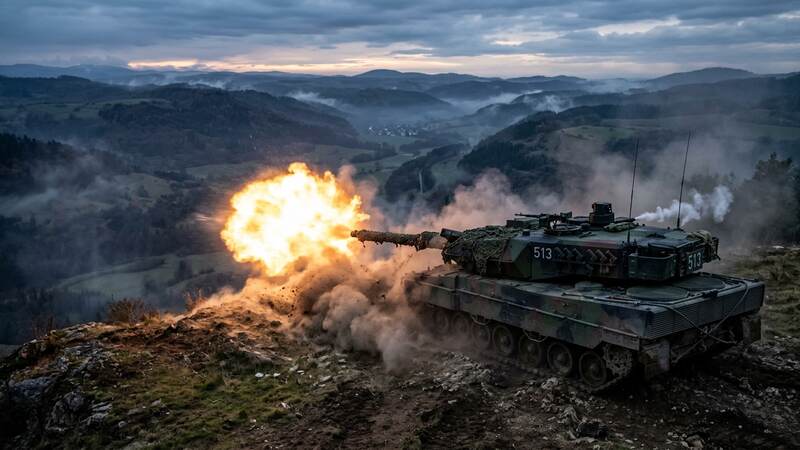
Simulation Core: Unlike arcade tank games that rely on arbitrary vehicle hit-point pools and RNG aiming circles, War Thunder calculates real-time projectile ballistics, three-dimensional Volumetric Armor thickness, and internal X-ray module/crew knockouts across more than 2,500+ historical aircraft, tanks, helicopters, and warships. Understanding which ammunition type to load—and exactly where internal ammo carousels and gun breeches sit—is the difference between an instant one-shot detonation and a harmless ricochet.
1. No Health Bars: The Internal Module & Crew X-Ray Architecture
When you fire a main cannon round in War Thunder, the server traces the physical projectile's flight path, muzzle velocity decay, angle of incidence, and normalization against the target's armor mesh. If the round penetrates, it does not subtract from a generic "2,000 HP" bar. Instead, it generates a cone of kinetic fragments (spall) and, if equipped with a bursting charge, detonates inside the fighting compartment after its fuse delay distance (typically 1.2 meters).
A ground vehicle in War Thunder is destroyed only when one of three physical conditions is met:
1. Crew Knockout: The surviving active crew count drops below 2 (or 1 in specific Swedish S-tank/strv 103 configurations with Commander Fire Control).
2. Ammunition Rack Detonation / Blowout Failure: Fragments or chemical jets ignite propellant charges or warheads stored in the hull or turret bustle without intact blowout panels.
3. Overpressure: High-Explosive (HE), HESH, or high-caliber HEAT rounds containing sufficient TNT-equivalent explosive filler rupture thin roof or cupola armor, sending a lethal shockwave through the entire crew compartment.
---
2. The Ammunition Matrix: APHE vs. APDS vs. HEAT-FS vs. APFSDS
Choosing the wrong primary shell—or carrying a full ammo load that packs your upper hull with explosive racks—is the #1 mistake new tankers make. Usually, you should carry no more than 16 to 22 total rounds so your secondary turret and hull ammo racks remain completely empty in the X-ray model.
| Shell Archetype | Era / BR Range | Penetration Mechanism | Post-Penetration Damage | Primary Counter / Weakness |
| :--- | :--- | :--- | :--- | :--- |
| APHE / APCBC (Armor-Piercing High Explosive) | WWII – Early Cold War (BR 1.0–7.7) | Kinetic steel mass + cap normalization | Extreme: 360° internal HE sphere explosion knocks out entire turret crews | Thick sloped homogeneous steel exceeding DeMarre penetration limit |
| APDS (Armor-Piercing Discarding Sabot) | Mid Cold War (BR 5.3–8.3) | Sub-caliber tungsten core at high velocity | Moderate/Linear: Narrow spall cone; requires surgical aiming at gunner/ammo | Extreme compound angles (>60°) can trigger shell shatter |
| HEAT-FS (High-Explosive Anti-Tank Fin-Stabilized) | Cold War (BR 6.7–9.3) | Chemical shaped-charge copper liner jet (distance-independent) | Focused Jet + Overpressure: Deadly against light vehicles; linear against MBTs | ERA (Explosive Reactive Armor), composite arrays, chain-link fences, and bushes |
| APFSDS (Armor-Piercing Fin-Stabilized Discarding Sabot) | Modern MBTs (BR 8.3–12.0+) | Long-rod depleted uranium or tungsten kinetic penetrator (1,450–1,750+ m/s) | High Kinetic Spalling: Pierces composite arrays and ERA; flat laser trajectory | Internal Spall Liners (T-90M, Leopard 2A7V, Strv 122B+) narrow the fragment cone |
---
3. Volumetric Shells & The "Overlapping Plate Trap"
In earlier eras of tank simulations, shells were modeled as infinitely thin 1-pixel mathematical rays. Gaijin Entertainment upgraded War Thunder to Volumetric Shells, giving every projectile its real physical diameter (e.g., an 88mm KwK 36 shell has an actual 88mm cylindrical collision volume, while a sub-caliber 120mm DM53 dart has a ~26mm rod diameter).
Why Volumetric Geometry Matters in Firefights
- Avoid Armor Seams: When a full-caliber 88mm, 100mm, or 122mm APHE shell strikes the exact horizontal seam where a Panther's or Tiger's side hull plate meets its horizontal sponson roof plate, the shell's physical radius touches both plates simultaneously. The engine sums the longitudinal depth of the horizontal plate, spiking effective thickness to 400mm+ and causing a non-penetration.
- Sub-Caliber Dart Advantage: Because APFSDS long-rod penetrators have a tiny 22–28mm physical cross-section, they slip cleanly through narrow turret ring gaps, driver optics ports, and gun mantlet slots that would catch a wide WWII full-caliber shell.
- Use the Hangar Protection Analysis Tool: Before queuing into battle, select any rival tank in the tech tree, click Preview → Armor → Protection Analysis, and simulate your exact shell at 500m to memorize where its internal ammo carousel or gunner optic sits.
Explore our full War Thunder Game Dossier, read our War Thunder Scored Review, watch our War Thunder Cinematic Breakdown, or download War Thunder Free on PC, Mac, PlayStation, and Xbox here with bonus starter vehicles.