
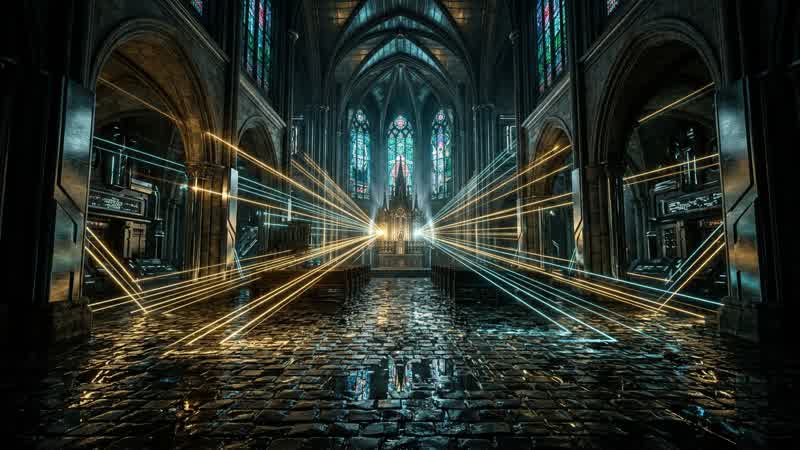
When NVIDIA introduced real-time hardware ray tracing in 2018, games used hybrid rendering: standard rasterization handled primary visibility and shadows, while a sparse budget of ray tracing was reserved for a single reflection pass or ambient occlusion.
Today, titles like Cyberpunk 2077 (Ray Tracing: Overdrive Mode), Alan Wake 2, Indiana Jones and the Great Circle, and Black Myth: Wukong offer Full Real-Time Path Tracing—unifying direct lighting from hundreds of dynamic emissive sources, multi-bounce global illumination, physically accurate soft shadows, and refraction into a single unified rendering equation.
How is this mathematically possible when an offline film renderer shoots 4,096 rays per pixel, while a real-time GPU at 60 FPS can only afford 1 to 2 primary paths per pixel? The answer lies in three algorithmic breakthroughs: ReSTIR GI, Opacity Micromaps (OMM), and Neural Radiance Caching (NRC).
Title: The 3 Algorithmic Pillars of Real-Time Path Tracing
Badge: Graphics Math
- ReSTIR (Reservoir-Based Spatio-Temporal Importance Resampling): Allows each pixel to share light-sampling history with its spatial neighbors and previous frames, multiplying effective sample quality by 60x to 100x.
- Opacity Micromaps (OMM): Encodes alpha-tested foliage and chain-link fences directly into hardware BVH triangles so rays do not stall invoking shaders on transparent leaves.
- Neural Radiance Caching (NRC): Terminates erratic multi-bounce paths after 1–2 bounces and queries an on-the-fly self-training neural network on Tensor cores for infinite indirect bounce lighting.
- Check Your Rig: Estimate your path-traced frame rate in our Real-World FPS Calculator.
1. ReSTIR DI & ReSTIR GI: Turning 1 Ray Per Pixel Into 100
In a neon-lit street scene in Night City, thousands of emissive signs, car headlights, and streetlamps illuminate every rain puddle. If a pixel randomly shoots a single ray into the scene, there is a 99% chance it misses the dominant light source entirely—resulting in severe stochastic grain ("fireflies" and noise).
Developed by researchers at NVIDIA and Dartmouth College, ReSTIR (Reservoir-Based Spatio-Temporal Importance Resampling) solves this using Weighted Reservoir Sampling:
- Temporal Reuse: Each pixel remembers the most significant light paths it discovered in the previous frame (`Frame N - 1`).
- Spatial Reuse: Each pixel inspects the reservoirs of its neighboring pixels on screen (`3x3` or `5x5` neighborhood). If a neighboring pixel found a bright neon sign contributing valid radiance to the same surface normal, your pixel adopts that statistical weight immediately without shooting extra rays!
2. Neural Radiance Caching (NRC) and Ray Reconstruction
Computing the first bounce of light off a wall is relatively fast, but tracing the 3rd, 4th, and 5th indirect bounces inside a dark room causes extreme cache thrashing. With Neural Radiance Caching, the GPU traces just one or two short rays and then queries a tiny, scene-adaptive Multi-Layer Perceptron (MLP) neural network that continuously trains itself every frame on real ray samples—filling in realistic infinite-bounce global illumination at a fraction of the compute cost.
Read our full review of path-traced visual fidelity in our Cyberpunk 2077: Phantom Liberty Review and Black Myth: Wukong Review.