
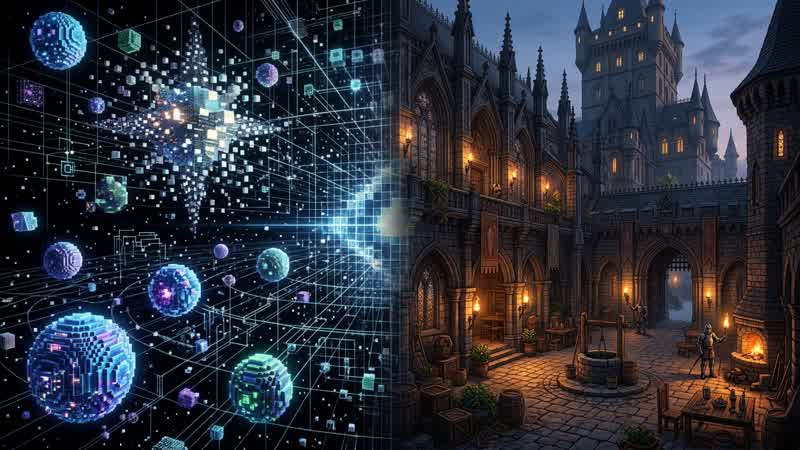
Few phrases in video game marketing generate as much hype—or as much skepticism—as "procedurally generated universe." On one side of the medium, games like Spelunky, Dead Cells, Deep Rock Galactic, Minecraft, and Binding of Isaac use procedural generation to stay fresh after 500 hours of play. On the other side, sprawling open-world RPGs that lean heavily on procedural planetary terrain often leave players fatigued after visiting their fourth identical outpost on a barren moon.
Why does procedural generation triumph in some genres and stumble in others? Because algorithms excel at remixing tactical permutations, but humans excel at intentional pacing, sightline composition, and environmental storytelling.
Title: The 3 Tiers of Level Generation Architecture
Badge: Design Philosophy
- 1. Pure Noise / Voxel Generation (Minecraft, No Man's Sky, Valheim): Works brilliantly when the player's primary verb is terraforming, building, or survival resource gathering.
- 2. Hand-Authored Room Grammar (Hades II, Dead Cells, Spelunky): Designers hand-craft hundreds of bespoke combat arenas or tile chunks, and the algorithm stitches them together with strict pacing rules.
- 3. Bespoke Architectural Level Design (Elden Ring Stormveil Castle, Dishonored 2, Dark Souls): Every sightline, shortcut elevator, and enemy ambush is deliberately placed to teach mechanics and tell a story without words.
Why Pure Procedural Generation Struggles With Narrative RPGs
In a narrative-driven RPG or immersive sim, a room is not just a geometry container for loot chests—it is a piece of detective work. When you walk into an abandoned laboratory in Prey or a ruined cathedral in Elden Ring, the placement of a skeleton reaching toward a locked door, the scorch marks on a pillar, and the vantage point through a broken stained-glass window are intentionally composed by a level artist to reward observation.
When an algorithm scatters props across 1,000 planets using probability weights, players quickly sense that the environment has no specific authorial meaning—so they stop looking closely at the world and start scanning only for glowing loot highlights.
The Hybrid Gold Standard: Authored Modules + Systemic Remixing
The smartest modern studios no longer treat procedural generation and hand-crafted design as opposites. Instead, they use Wave Function Collapse (WFC) and Graph Grammar Rules to assemble human-authored building blocks:
- In Hades II and Slay the Spire 2, every individual encounter room and boss phase is meticulously hand-tuned, while the reward sequence and boon synergies shift every run.
- In puzzle classics like Mahjong Classic in our Playgama Hub, algorithmic board generation guarantees that every randomized tile stack is 100% mathematically solvable while keeping each game fresh.