
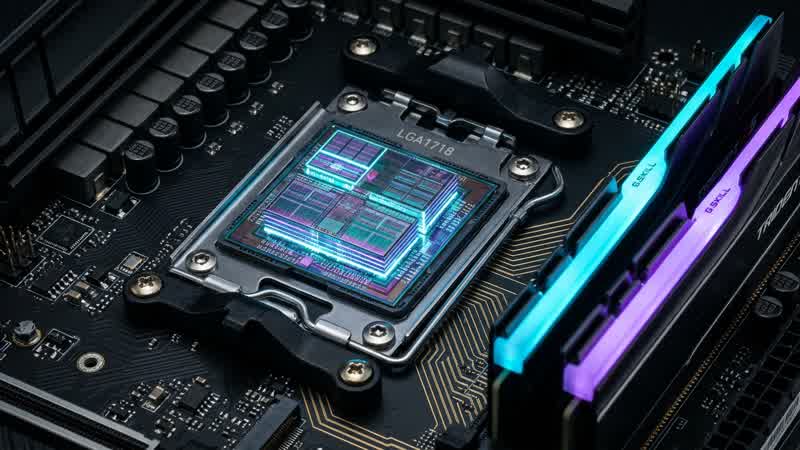
For decades, PC gamers evaluated processors primarily by two numbers printed on the box: Core Count and Boost Clock Frequency (GHz). Yet when you test complex simulation, strategy, and open-world games in our Real-World FPS Calculator—such as Baldur's Gate 3 (Lower City), Escape from Tarkov (Streets of Tarkov), Microsoft Flight Simulator 2024, or Factorio: Space Age—an 8-core X3D processor with 96MB of stacked 3D V-Cache routinely beats standard 16-core and 24-core CPUs running 600 MHz higher.
Even more intriguing: on non-X3D processors with standard 32MB–36MB L3 caches, tightening DDR5 primary and secondary memory timings (`DDR5-6000 CL28 + tuned tREFI/tRFC`) yields up to a 19% jump in 1% low frame rates, whereas that exact same expensive RAM kit adds less than 3% on a 3D V-Cache chip. Why? Because of the physics of CPU Cache Hierarchy and Pointer-Chasing Latency.
Title: CPU Memory Hierarchy Access Latency Breakdown
Badge: Microarchitecture
- L1 Data Cache (32KB–48KB per core): ~1.0 to 1.5 nanoseconds (`4–5 clock cycles`).
- L2 Cache (1MB–2MB per core): ~3.5 to 4.5 nanoseconds (`12–16 clock cycles`).
- L3 Cache (32MB Standard vs. 96MB 3D V-Cache): ~10 to 14 nanoseconds (`~40–50 clock cycles`).
- System DDR5 RAM (Off-Chip IMC Fetch): ~58 to 78 nanoseconds (`250+ wasted CPU clock cycles` where the execution core sits completely stalled waiting for data!).
Why Game Engines Are "Pointer-Chasing" Nightmares for CPUs
Unlike video encoding or Cinebench 3D rendering—where the CPU processes contiguous arrays of predictable floating-point numbers that hardware prefetchers can easily guess ahead of time—a video game main loop is an unpredictable web of object references (known as Pointer Chasing).
During a single 16.67ms frame in Kingdom Come: Deliverance II or S.T.A.L.K.E.R. 2: Heart of Chornobyl, the CPU must iterate through 400 NPC entities, check their AI behavior trees, query inventory pointers, evaluate collision bounding boxes, and build DirectX 12 draw-call command lists. When the active entity working set exceeds 32MB, a standard CPU suffers millions of L3 Cache Misses per second—forcing the core to wait 65 nanoseconds per miss for system DDR5 RAM.
By tripling the L3 cache from 32MB to 96MB via copper-to-copper hybrid bonding (`3D V-Cache`), the entire entity state table stays on-die at 12ns latency—eliminating over 60% of off-chip RAM trips.
How to Optimize Your Build in 2026
1. On AMD 3D V-Cache CPUs (7800X3D / 9800X3D / 9950X3D): Do not overspend on exotic DDR5-8000 memory kits that force the memory controller into `2:1 (UCLK = MEMCLK/2)` divider mode. Instead, run a rock-solid 2x16GB or 2x32GB DDR5-6000 CL30 EXPO kit in `1:1 synchronous mode` inside our Custom Gaming PC Builder and invest the savings directly into your GPU.
2. On Standard Non-X3D AMD or Intel Core Ultra CPUs: Because L3 misses happen far more frequently, memory latency directly governs your 0.1% lows. Enable EXPO/XMP, ensure your two DIMMs sit in motherboard slots A2 and B2, and prioritize low CAS Latency (`CL28–CL30`) alongside a high Refresh Interval (`tREFI = 50000–65535`).